
Application security used to mean waiting three days for a massive PDF report telling you that a test file is a critical threat. This breakdown compares the bloated, legacy approach of Checkmarx against the modern, developer-first philosophy of Aikido, revealing why engineers are actively rebelling against traditional scanning tools.
The cybersecurity industry loves selling fear. For the past decade, massive enterprise vendors have gotten incredibly rich by convincing management teams that the only way to protect a codebase is to buy a clunky platform that takes six months to integrate. These legacy systems treat developers like an afterthought. They act as if the engineering team’s sole purpose is to triage thousands of automated alerts instead of actually building software.
This brings up the classic David and Goliath battle currently happening in the application security space. On one side, there is the old guard, representing the heavy, traditional way of doing things. On the other side, newer platforms like Aikido are stepping in to fix the exact headaches that traditional tools created in the first place. The contrast between these two philosophies is stark, and picking the wrong one will absolutely tank engineering productivity.
The Enterprise Dinosaur in the Room
Checkmarx has been around forever, and it is the textbook definition of legacy enterprise software. It takes multiple calendar meetings just to get a basic price quote, onboarding takes weeks and it practically requires a dedicated team to figure out the dashboard. When management buys into this ecosystem, they are purchasing a massive suite of disconnected tools that supposedly cover every single edge case in existence. The reality looks much different on the ground. Engineering teams end up actively ignoring the scanner. When an application security platform takes six hours to run a basic scan, people simply stop running it. Trying to integrate a heavy legacy scanner into standard CI/CD pipeline workflows usually results in broken builds and massive bottlenecks. Developers do not want a tool that stops the entire assembly line just to flag a theoretical vulnerability in a piece of abandoned documentation.
Developers Hate False Positives
The biggest crime committed by legacy security tools is the absolute avalanche of false positives. Traditional scanners are terrified of missing something, so they flag literally everything. A tool that cries wolf four thousand times a week is less than useless; it is an active distraction. Developers are forced to waste countless hours proving that a flagged issue is not actually a threat, digging through obscure code just to satisfy a broken algorithm.
The modern approach completely flips this script. A developer-centric tool recognizes that alert fatigue is a massive danger to productivity. The focus moves from flagging everything to only flagging what actually matters in the real world. By consolidating different types of scans into one platform and ruthlessly filtering out the noise, modern alternatives give developers actionable alerts they can fix in five minutes. Nobody wants to sift through a massive spreadsheet of false alarms on a Friday afternoon.
The Speed of Shipping
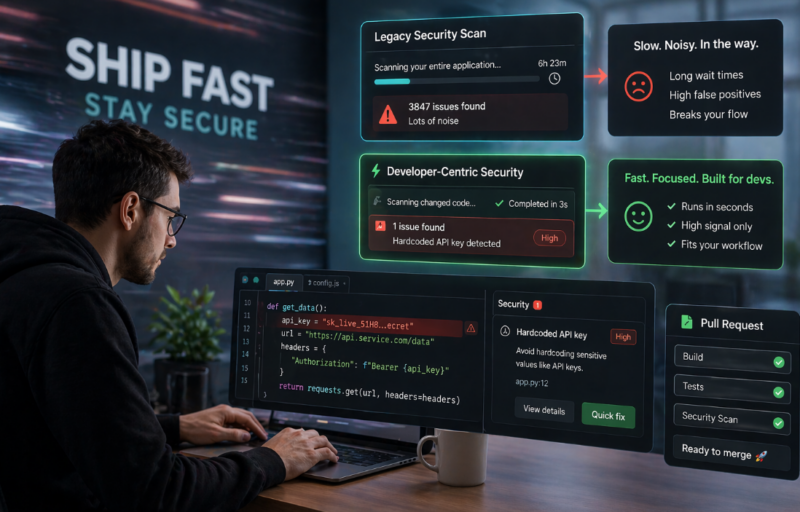
Writing code is all about momentum. When someone gets into the zone, the last thing they need is a security platform slamming the brakes. Legacy platforms like Checkmarx were built for an era where software was released once a quarter. Today, teams are deploying code multiple times a day. If a vulnerability scan takes longer than a coffee break, it is completely incompatible with modern engineering velocity. Developer-centric security tools are built to run fast.
They integrate directly into the code editor or the pull request process, giving immediate, localized feedback. If a developer accidentally hardcodes an API key, the tool slaps their wrist instantly before the code ever reaches the main branch. It is a pragmatic, frictionless way to handle security that does not require scheduling a meeting with the compliance department.
Paying for Features You Never Use
Enterprise sales teams are notoriously good at upselling features that sound amazing in a boardroom but are totally useless in practice. Traditional application security platforms are bloated with complex reporting matrices and compliance modules designed specifically to impress executives. The actual engineering team rarely touches most of the interface. This bloat comes with an incredibly steep price tag.
Paying exorbitant licensing fees for a platform that actively slows down development makes zero financial sense. Leaner, developer-first tools strip away the corporate bloat. They offer straightforward pricing models, transparent features and completely skip the aggressive sales tactics. The money saved by avoiding massive enterprise contracts can be redirected toward actually building better software, rather than just buying expensive dashboards that nobody looks at.

The Pragmatic Choice
Sticking with legacy security scanners is a fantastic way to make an engineering team hate their jobs. The old method of tossing code over a wall to a security analyst and waiting days for a giant PDF report is completely dead.
Modern development requires tools that treat engineers like humans, not alert-triage machines. Ditching the enterprise dinosaurs for streamlined, focused platforms is not just a trend. No, it is a basic survival tactic for any team trying to ship code quickly without accidentally leaving the front door wide open. The industry is moving past the era of bloated software, and clinging to the old way of doing things is a terrible strategy.